
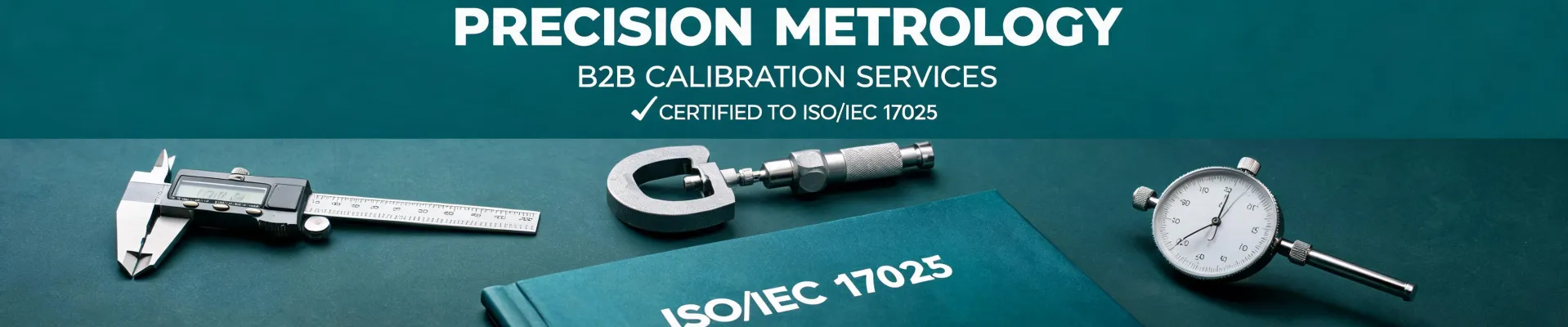
Ask five quality engineers to name the best measuring tool, and you'll get five different answers. That isn't because they are confused. It's because they're solving different problems.
I review precision instruments before they go out to manufacturing customers—roughly 1,200 items a year. After four years of that, I've stopped asking 'which brand is best?' and started asking 'what failure are we trying to prevent?' It took a few expensive surprises to get here.
The tool is not the answer. The measurement is. This post is about figuring out which type of measuring tool belongs in front of you.
Start with the task, not the brand
If somebody asks me for a recommendation, the first thing I want to know is not Starrett vs Mitutoyo. It's what they're actually measuring. I roughly group requests into four buckets:
- Static mechanical dimensions—outside diameter, thickness, depth—call for a caliper or micrometer.
- Movement, runout, or relative position—call for a dial indicator or a test indicator.
- Electrical quantities—voltage, current, resistance—call for a multimeter, not a handheld gage.
- Continuous feedback or automated inspection—call for an encoder or a vision system.
Most tool-buying arguments happen when people mix those buckets. A machinist may love a Starrett caliper and still need an encoder to feed a PLC. A quality manager may need a dial indicator on a fixture and a vision system on the line. Different problems, different tools.
Bucket 1: The part is on the bench
When I need to measure an outside dimension quickly, I reach for a 6-inch caliper. It's fast, portable, and good enough for most rough checks. If the drawing tolerance is ±0.005 inch, a caliper is fine. If it's tighter than ±0.001 inch, I switch to a micrometer.
This is where Starrett earned most of its reputation. I use Starrett calipers, but I have also used Mitutoyo enough to know that the two brands are closer than forum arguments suggest. The bigger difference is usually operator training and calibration schedule.
Where are Starrett calipers made?
One question that shows up constantly is 'where are Starrett calipers made?' It's a fair question, especially for customers with domestic-content requirements. The honest answer depends on the exact model and the date it was manufactured. Starrett was founded in Athol, Massachusetts, and its U.S. operations are still active. But Starrett also has production outside the U.S., and some current caliper models are made there. I have opened boxes with different country-of-origin marks for different part numbers. The only reliable answer is to check the label on the current product before you buy.
Country of origin does not guarantee performance. I have seen a US-made tool arrive with a damaged contact, and I have seen imported tools pass every check in the calibration room. If your contract demands a specific origin, verify it. If it doesn't, focus on calibration history, repeatability, and support.
Bucket 2: Runout, clearance, and small movement
A caliper cannot measure runout. It has no stable reference while the part rotates or moves. For that job, you need some form of indicator.
When someone asks about a Starrett Last Word dial indicator, they usually mean the compact Starrett test indicator with the pivoting contact point. I've mounted a Last Word on a magnetic base next to a rotating spindle more times than I can count. The zero point can be adjusted, the contact fits into tight spaces, and the movement is visible immediately.
The Last Word isn't the cheapest indicator in the drawer. But if you compare the total cost over three years of daily use, the more robust mechanism has usually paid for itself. That's not a marketing slogan; it's a maintenance cost argument.
Setup matters more than the brand. I once watched a new inspector mount an indicator so the contact point was parallel to the surface instead of perpendicular. The needle moved and gave a number, but the number was meaningless. The tool was not defective. The geometry was wrong.
Bucket 3: Electrical, motion, and machine feedback
This is where brand loyalty gets dangerous. A precision measuring company that makes excellent calipers doesn't automatically know how to make a safe multimeter. If you are measuring voltage, current, or resistance, use a multimeter designed for the environment.
For mains work, look for a meter with an independent safety rating such as IEC 61010-1 CAT III or CAT IV. I carry a Fluke in my own kit because of its safety ratings and reliability, but the brand is less important than the rating and probes. A 'bargain' meter that fails while connected to high energy is not worth the savings.
When a machine needs continuous feedback, use an encoder
Different situation: you need to know the position of a rotating shaft while it is moving. A dial indicator won't feed a PLC. This is where an industrial encoder is required.
If the drawing specifies an encoder DFS60 from SICK, the part number includes details like resolution, shaft size, voltage, output type, and connector. Those details are not optional decoration. I learned this by approving a cheaper 'equivalent' encoder because the shaft size and pulse count matched. The output circuit did not match. The machine made an unexpected move and damaged a fixture. The savings were about $90. The repair cost was not $90.
Bucket 4: Automated, high-volume inspection
Once the inspection task repeats hundreds of times per shift, manual gaging stops being practical. A machine vision system can check dimensions, detect defects, confirm assembly, and record results automatically.
One question I see in search logs is 'does Cognex use Sony sensors?' The short answer is: in some models, yes, and in some models, no. Cognex builds vision systems around image sensors from multiple suppliers, and the sensor supplier can change during the life of a product without changing the model name. I do not choose a vision system by sensor brand. I choose it by image quality, resolution, global shutter, software, lighting, and demonstrated performance on a known set of good and bad parts.
How to tell which bucket you're in
If you are still unsure, walk through four questions in order:
- Is the thing you care about a physical dimension of a part? If yes, start with calipers or a micrometer.
- Is it movement, runout, or relative position? If a human watches a dial, choose an indicator. If a machine must use the signal, choose an encoder.
- Is it an electrical quantity? Use a properly rated multimeter.
- Do you need to make the same inspection thousands of times with no human judgment? Use a vision system.
After the tool type is clear, compare total cost, not just unit price. A Starrett caliper is not automatically worth its price because of the logo. It is worth it when it repeats well, survives shop-floor use, and has calibration support behind it. A Fluke multimeter is worth it for the same reasons. An encoder or vision camera is worth it when the manufacturer can prove it solves your specific problem.
I've been burned by assuming that similar-looking products are interchangeable, and I've also paid extra for a famous name when a simpler tool would have done the job. The way to avoid both mistakes is to define the measurement before the brand conversation starts.

Marcus Feld
Marcus Feld is an electrical test and measurement analyst specializing in multimeters, oscilloscopes, clamp meters, insulation testers, spectrum analyzers, and data loggers. He applies IEC 61010-2-030 and IEC 61010-031 concepts while examining measurement category, bandwidth, true-RMS response, input loading, and stated uncertainty. His work helps maintenance engineers and test teams choose safe instruments with performance suited to the signals and environments they actually measure.
Leave a Reply